


NEWS

2025-10-22
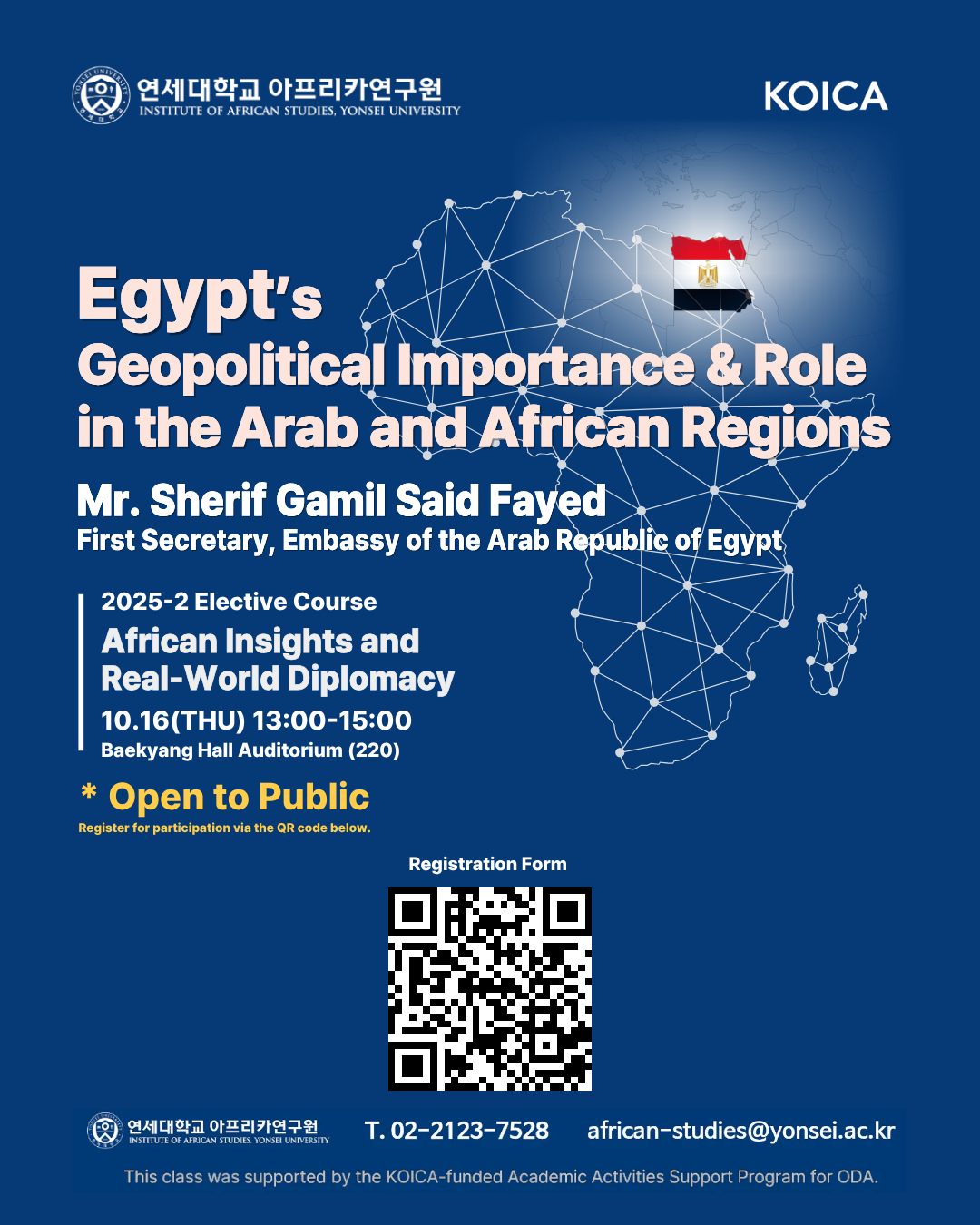
연세대학교 아프리카연구원 방사무엘연상 교수님과 정치외교학과 이인복 교수님의 지도로 운영되는 교양수업 “African Insights and Real-World Diplomacy”가 2025년 가을학기에 개설되었습니다. 본 강의는 아프리카 각국의 대사님들을 특별 연사로 초청하여, 학생들과 일반 참가자 모두가 아프리카의 현실과 외교 현장을 직접 경험할 수 있는 뜻깊은 자리를 마련하고 있습니다.
이번주 10/16 (목)에 진행된 강의는 주한 이집트 대사관 1등 서기관, Mr. Sherif Gamil Said Fayed 께서 Egypt's Geopolitical Importance & Role in the Arab and African Regions를 주제로, 특별 연사로 참석해주셨습니다.
서기관님께서는 먼저 수에즈 운하(의 전략적 중요성을 소개하며, 세계 무역의 약 12%가 통과하고 연간 50억 달러의 수익을 창출하는 운하가 이집트 경제의 핵심 기반임을 강조하셨습니다. 또한 북극항로 개척으로 인한 물류 경쟁 심화에 대응하기 위해, 이집트가 친환경 산업 중심의 경제지대(SCZone)를 개발하며 새로운 성장동력을 확보하고 있음을 설명하셨습니다.
이어 아랍연맹의 역사와 카이로에 위치한 본부를 언급하며, 가말 압델 나세르 대통령이 주도한 범아랍주의(Pan-Arabism)와 탈식민 독립운동, 그리고 아프리카 해방운동에 대한 기여를 통해 이집트가 아랍과 아프리카 모두에서 중심적 위치를 차지하게 되었음을 강조하셨습니다.
이집트는 현재 세계 10위권의 군사력을 보유한 국가로서 미국•EU의 전략적 동맹국 중 하나이며, 가자지구 분쟁 중재 등 중동 지역 외교 현장에서 핵심적 역할을 수행하고 있다고 설명하셨습니다. 또한 중동의 할리우드로 불리는 영화 산업을 중심으로 한 문화외교를 통해, 아랍 세계의 문화와 정체성을 세계에 알리고 있다고 말씀하셨습니다.
아프리카 내 역할에 대해서는, 이집트가 아프리카연합(AU)의 창립국으로서 대륙 통합과 협력의 리더십을 발휘해왔음을 강조하셨습니다. 아울러 국가 수자원의 95%가 나일강에 의존하고 있어 물 안보가 국가의 핵심 과제로 떠오르고 있으며, 이에 따라 에티오피아와의 GERD(그랜드 에티오피안 르네상스 댐) 분쟁 중재에도 적극 나서고 있다고 설명하셨습니다. 또한 급속한 인구 증가로 인한 사회적 과제 역시 국가적 차원에서 중요한 정책 논의의 대상이 되고 있음을 덧붙이셨습니다.
끝으로, 서기관님은 신행정수도(New Cairo) 건설과 스마트시티 개발, 그리고 2025년 개관 예정인 세계 최대 단일 문명 박물관 ‘그랜드 이집션 뮤지엄’ 등 이집트의 국가 현대화 프로젝트를 소개하며, 이집트가 전통과 현대화를 아우르는 국가 비전을 실현해가고 있음을 전하셨습니다.
향후 본 강의는 여러 주한 아프리카 대사 및 전직 대사님들의 초청 강연을 통해 아프리카와의 교류를 지속적으로 확대하고, 학생•교수•전문가가 함께 참여하는 지속 가능한 학문적 교류의 장을 마련할 예정입니다.
The liberal arts course “African Insights and Real-World Diplomacy” (YCI1903-01), directed by Professor Samuel Y. Pang (Director of the Institute of African Studies at Yonsei University) and Professor Inbok Rhee (Department of Political Science and International Studies), was newly offered in the Fall 2025 semester.
The course invites ambassadors from various African countries as guest speakers, providing both students and the general public with a meaningful opportunity to experience Africa’s realities and the practice of diplomacy firsthand.
On Thursday, October 16, Mr. Sherif Gamil Said Fayed, First Secretary of the Embassy of the Arab Republic of Egypt in Korea, was invited as a special guest lecturer and delivered a talk titled “Egypt’s Geopolitical Importance & Role in the Arab and African Regions.”
Mr. Fayed began by outlining the strategic significance of the Suez Canal, through which about 12 percent of global trade flows, generating around USD 5 billion annually and serving as a vital pillar of Egypt’s economy. He noted that, in response to emerging competition such as the Arctic Sea Route, Egypt is developing the Suez Canal Economic Zone (SCZone) as an eco-industrial corridor to drive sustainable growth.
He then discussed the history of the Arab League, headquartered in Cairo, and highlighted how President Gamal Abdel Nasser led Pan-Arabism, decolonization movements, and supported African liberation efforts, establishing Egypt as a central actor across both the Arab world and the African continent.
Mr. Fayed emphasized that Egypt, currently ranked among the world’s top 10 military powers, serves as a strategic ally of the United States and the European Union, playing a key diplomatic role in regional affairs such as the Gaza conflict mediation. He also introduced Egypt’s “Hollywood of the Middle East”—its film industry—as a core tool of cultural diplomacy that shapes and shares Arab identity on the global stage.
Within Africa, Egypt remains a founding member of the African Union (AU) and a leader in continental integration and cooperation. He stressed that water security is one of Egypt’s most pressing national issues, as 95 percent of its freshwater depends on the Nile River, and explained Egypt’s mediating efforts in the GERD (Grand Ethiopian Renaissance Dam) negotiations with Ethiopia. He also mentioned that rapid population growth poses new social and economic challenges requiring long-term national strategies.
In conclusion, Mr. Fayed introduced Egypt’s ongoing national modernization projects, including the construction of the New Administrative Capital (New Cairo), the development of smart city infrastructure, and the upcoming Grand Egyptian Museum (GEM)—the world’s largest single-civilization museum—set to open in 2025. These initiatives, he noted, embody Egypt’s vision of bridging tradition and modernity.
This lecture offered students a valuable opportunity to gain deeper insight into Egypt’s geopolitical importance, diplomatic leadership, and cultural influence. The course will continue to host African ambassadors and former diplomats, fostering a sustainable platform for academic and cultural exchange between Yonsei University and Africa.
